AKALAN Kathak performances July 2022
https://www.lokmattimes.com/aurangabad/artists-enthrall-audience-in-akalan-kathak-performance/
AKALAN Kathak performances July 2022
https://www.lokmattimes.com/aurangabad/artists-enthrall-audience-in-akalan-kathak-performance/
Films can play a significant role in understanding a dance tradition. Every dancer (or perhaps the better ones) is a living archive. They are custodians and repositories of a certain training, legacy, aesthetics and performance tradition. This came through clearly at the recently held festival of films on Indian classical and contemporary dance titled ‘Punaravalokan’ (looking back) held at Mahagami Gurukul in Aurangabad.
Think about Satyajit Ray’s Bala (1976) for instance, which isn’t a great film so to speak but nevertheless documents an important moment in Indian dance history. All the admirers of Kelucharan Mohapatra eventually turn to Kumar Shahani’s Bhavantarana (1991) to be captivated by the maestro’s matchless grace. Film therefore is a museum too. This observation was further corroborated by noted filmmaker and Dadasaheb Phalke award winner, Adoor Gopalakrishnan who was the chief guest at Punaravalokan and also participated in a conversation with the audience after the screening of two of his films at the festival, Kalamandalam Gopi (1999) and Dance of the Enchantress (2007).
Kalamandalam Gopi features legendary Kathakali maestro, Gopi, who was trained at the Kerala Kalamandalam. The film documents all the elements of Kathakali including make-up, costume, music and vividly portrays the training process an aspirant has to undergo. In a much later film, Dance of the Enchantress , Adoor showcases the evolution of Mohiniyattom through parallel stories of a teacher and her pupil. Both films also include some captivating performance footage shot at various locations across Kerala. These films not only serve as an exposition for the uninitiated but also play a major role in archiving dance heritage and some of its foremost practitioners.
In the conversation that followed the film screening, Adoor revealed his affinity for Kathakali. He said, “I started watching Kathakali from my mother’s lap. As a child, I used to be interested in the make-up of the artistes because each type denoted a specific character. Besides, there was drumming and singing. I gradually began to appreciate the importance of lyrics. My mother would explain the stories before the performance because you will not understand the recital without knowing the story.”
However, in his youth, Adoor was drawn to modern theatre. He rediscovered Kathakali much later. He informs, “There was a long gap in between. I slowly went back to follow Kathakali. The first such documentary I made was on a famous guru, Chenganoor Raman Pillai. He was almost 92 when I shot the film. Years later, I made this film on Gopi which captures him at his peak. I also made another film on Guru Ramankutty Nair who was Gopi’s guru. In this process, I realised why Kathakali ought to have been discovered in Kerala and not any other place.
Film on Krishnanattam
Adoor Gopalakrishnan also made a film on Krishnanattam, the precursor to Kathakali. He explains, “Both Krishnanattam and Kathakali have their origins in Koodiyattam which is being performed for the past 2000 years. It is the oldest living theatre in the world. You can sit anywhere in a Koothambalam (temple theatre) and hear the performers during a Koodiyattam performance. Kathakali is more accessible than Koodiyattam. There are a few in Kerala who have seen the full act of a play in Koodiyattam which usually takes between 15-45 days to perform. It survived because it was confined to the Chakyar community in Kerala, who were the custodians of this art form.”
Adoor often says when a Koodiyattam performance begins, everything around it ceases to exist. It was largely owing to the efforts of noted scholar Sudha Gopalakrishnan that Koodiyattam was recognised by the UNESCO as “Masterpiece of the Oral and Intangible Heritage of Humanity”. Adoor’s three-hour long documentary on Koodiyattam had the UNESCO team enthralled. He adds, “Koodiyattam artistes were extremely demoralised because there were few opportunities to perform and almost no audience. Kathakali on the contrary witnessed a steady ascent. Kathakali artistes were travelling all over the world and being handsomely paid. UNESCO sent a member of their team to Trivandrum to see my film. After the recognition, things are much better now. Money has been granted to the performers and several revival efforts are already underway. I feel gratified.”
The revered filmmaker insists that the audience watching his films should feel that they are watching a performance on stage. He is not a fan of abstraction in art-based documentaries. Adoor feels that dance films must convey every bit of aesthetics of the form which has also been a perennial quest in these films. His preparation for such projects is also meticulous. The Mohiniyattom documentary took around seven years to make. Adoor read every possible book available on the dance form and also saw some of the earlier films made on the subject. He chose to eschew background commentary and interviews. The focus remained on dance as it should because that perhaps is the origin of all dialogue.
Kunal Ray teaches literary and cultural studies at FLAME University, Pune and regularly writes on art and culture.
| Evolution of dance - over aeons, everywhere Photos courtesy: Mahagami June 7, 2022 Dance has generally been recognized by the cognoscente as an embodiment of the rhythmic, harmonic and aesthetic expressions that man could achieve in his relationship with himself and with the wide open world since the very time of Creation. Indeed, once the arboreal monkeys came down on the solid ground on their two feet and liberated hands for numerous other functions, they became Homo erectus and could make many gestures and create arbitrary patterns and movements. Generations later evolved the Homo sapiens - that is, the modern we - with our all-embracive cultural heritage, including that of dance. [Some scientists have also predicted that we are evolving now into Homo Deus (God-like beings), with our manifold enhancement of thinking power by connecting computers to our brains through information technology as well as enhancing our physical prowess and resistance to all diseases through highly superior biotechnology. One wonders if these would include evolution of a Meta-verse of arts with Artificial Intelligence and Machine Learning (AI/ML), and create a new kind of Virtual Reality and Augmented Reality (VR/AR) where new dance movements could be created and seen in an immersive technology, as are already being done for style designs!] 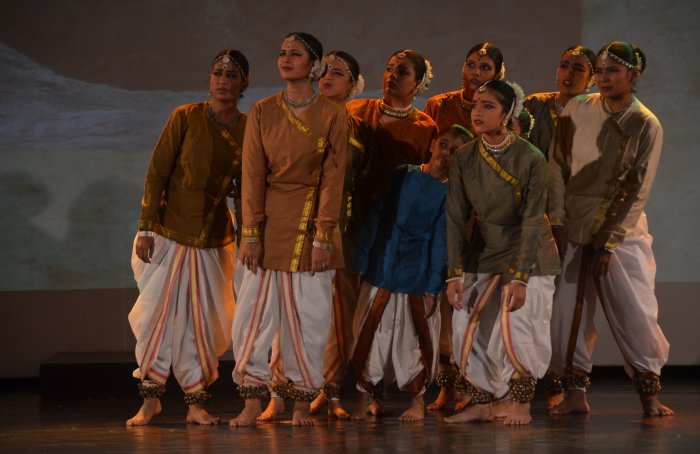 Early man Dance 360 Degrees: Sarvatra Nritya, an ambitious programme, presented by Mahagami University, Performing Arts Department, on the World Dace Day (April 29), offers a unique comprehensive vision into the origin of dance. Conceived and directed by their gifted Dean, Parwati Dutta, the curtain-raiser, Scene 1, finds the bemused dancers observing every activity of Nature with curiosity and confusion. It is as though the humans, as the new denizens of earth, are trying to "learn" from every encounter, experience and effort. This is the pre-history of three lakhs years ago: cognition of the five sensory perceptions of Roopa, Rasa, Shabda, Sparsha, Gandha... Dhun-te-ta/dhun-ta... man is daily taken to new discovery, new quest, new questions, new revolutions, new truths. He tries to follow the flow of life, the pace of life, cycle of life by observing animals and birds. It is the life of hunter-gatherers: by collecting as gatherer and consuming the fruits and vegetables; and surviving as a hunter, having observed carnivores living on their prey. There is no language, no source of communication, no script, no shelter, no ability to comprehend any principle of nature. Man tries to observe carefully every movement, every change of seasons, and stars thinking: How do these acts unfold? Who is doing this? Who is the creator, our fosterer? Where do I find him? Scene 2 begins with resonance of ghungroos, heralding rain. Upanishad's verse resounds: Truth lies concealed in a golden mound / so do you, O sun! / Open the entry to that cover / Be visible to me / A devotee who is truthful by nature / in the light of your illuminating grace...Dancers are in a prayerful mood. Then begins the mind boggling circumambulation of the immense universe of knowledge, one by one. 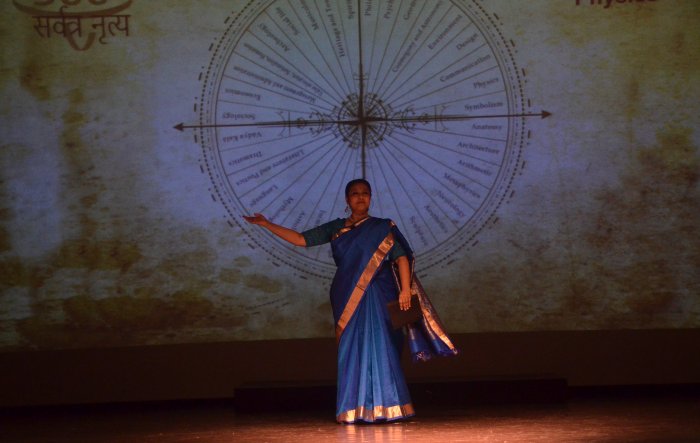 Parwati Dutta "Philosophy" is ushered in first as an inspired narrative, "How can dance be a way of knowing? It moves and it changes... There is an impermanence reflecting the absence of stable art objects. Is dance an ephemeral art? Philosophers don't perceive thought as a purely intellectual activity, but as a two-way dynamic exchange between the world and the active perception of an individual. Dance then can be a model path of thinking itself..." On the forestage is contemplative dance in Kathakali mould, with silhouettes of playing mizhavu in the background. "Psychology" flits in with bhava, rasa, but is given a short shrift. "Physics" comes in then with the narrative on dance technique, dynamics, centre of gravity, like the solar plexus (a favourite point of Martha Graham). Odissi and Kathak dancers demonstrate poses and postures: the vocabulary of lifts, spins, leaps, turns, balance, central axis, gravity, with laya, speed, tempo. Momentum reigns: angular momentum, angular velocity, centrifugal force, centripetal force, torque. It appears to be director's favourite! "Geometry" follows where dancers move as the narrator speaks, but not much. The narrative resounds, "A dancer's body is the source and the medium, for various shapes, forms and dimensions in the 2-D and 3-D space. A man can observe own shadow cast on the floor at varying points of time in the day, or against a water body, or on a reflecting surface: to define a thesaurus of forms by changing the way to stand, bend, sit, fall ...A dancer's body can stand erect to create a straight line or use a slight bend to create a chiaroscuro of curves... Lines and curves transform into crescents, spirals, spherical... By maneuvering joints and ligaments, the dancer understands geometric forms: Anga, pratyanga, Upanga... "Cosmogony/ Astronomy" is again a narrative on the universe, where celestial bodies dwell in an orderly way. The voice goes on, "The celestial bodies move in an orderly way. The direction, path, pace and purpose seem to be defined. Time taken by Mercury to complete one solar orbit is four times the duration of earth, while Venus takes one and half times that of earth..." The dancer displays these through time-cycles and laya sequence. The narration moves to "symbolism": connotations of movements, positions and stances. A solo dancer uses Kathak, accompanied by Dhrupad, interpreted as Dhyan, with 'Om' as in meditation. 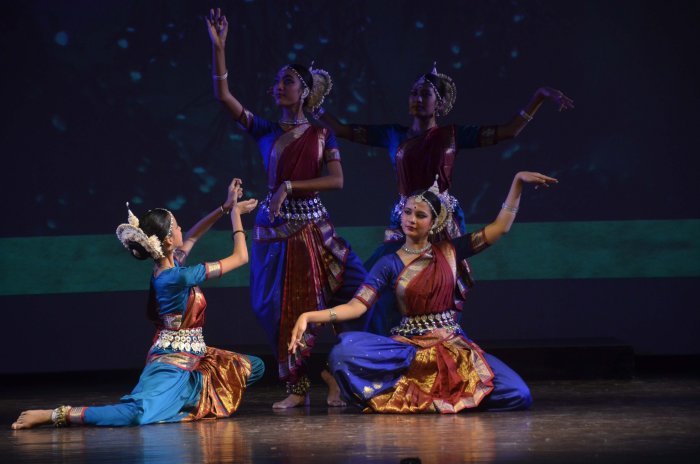 Environment "Environment" - with sounds from Nature in Gurukul, and utterances of animals and birds that follow these sounds -- is among the most inspired part of the programme -- like 'dhalang' for a lion's leap; 'jhijhikita' for the crickets; 'jhanak jhanak' for sound of ghungroos; the little bird's quest for water to quench her thirst after the rains; and so on. A male/female duo does a wonderful job of mimicking, followed by the Jalabindu song in Sanskrit sung with Odissi. "Design" is yet another delightful segment, with multiple ways of designing and redesigning space and time, and numerous ways the body can be used. An example is Matraa as the smallest unit and Bols come as symbolic structures as the building blocks, creating designs with rhythms. The dancers execute Tihais showing Gopuchcha and various Yatis on stage. "Communication" is yet another striking part in a long programme, highlighting verbal, non-verbal, interpersonal and intrapersonal aspects. With a popular Odissi composition Pratibimb (Reflection), three female dancers look into a mythical mirror using many motifs of a Pallavi in raga Jog showcasing all the four motifs fascinatingly. "Anatomy" follows, with the narrative highlighting limbs, joints, flex, stretch, twist, compress, et al. Dancers show preparation of the body through warm-ups, cool downs, stretches, healings... By far, the most fascinating part is "Architecture", with its wealth of illustrations from temple sculpture where the architect visualized it as a human form. A solo Odissi dancer presenting Mangalacharan enters with a unique Chali suggesting the idea of climbing steps in a sacred space. The full turn of the dancer marks the Nandi Mandapa and presenting the Bhoomi Pranam, points at the deities of Jagannath, Subhadra and Balabhadra. After offering Pushpanjali, she defines the arches in the eight directions and the imaginary arches. The dancer concludes with Trikhandi Pranam and the coordinates -- pointed at and defined by the dancer -- creates a virtual architecture out of Shoonya (the empty space). "Arithmetic" comes then, and the idea of aligning a rhythmic phrase in various speeds and multiples (as in Kathak) is just the beginning of the idea of arithmetic. Tihai is a composition that has calculations differing for odd numbers, even numbers, prime numbers. Tihai has many variants - Farmaishi Chakradhaar, Kamali and so on, making 'dha' as a determinant for various segments. "Metaphysics" as a branch of philosophy dealing with nature of existence, truth and knowledge, is then taken up by three Odissi dancers to illustrate how dance can be continually renewed by creation of new movements. The narrative continues: Art is not something separate from the "being" of the artist, but it is the quintessence of her existence, manifest through a skillful practice of her art. In this practice, the two extreme states of existence - spirit and matter generally perceived as opposed to each other - completely coalesce under the harmony of body, mind and spirit. For "neurology", the narrative brings out how dance induces subtle changes in the brain through a process known as plasticity, which induces the brain to adapt in response to experiences. While many elements of a rich narrative cannot be illustrated by a full performance due to sheer pressure of time, they are simply given as a demonstration. "Aesthetics" and "sculpture" are, however, beautifully illustrated with the cyclorama lit up by magnificent visuals of temple friezes and human figures sketched by early Indian and Italian painters, while three Odissi and three Kathak dancers evince their skills, vibrant with movement, rhythm and expression. The interaction of the movement structures and interrelationships of the components of the dance are captured in a Jhaptal Tarana that highlight the aesthetic beauty of Kathak, while Odissi presents excerpts from Batu Nritya highlighting the sculptural poses of Odisha temples through various Bhangis like Mardala, Parshva Mardala, Alasa, Darpani... "Painting" narrates how both space and time act as a canvas to the dancer while the dancer traces various strokes, shapes, forms in both space and time. She creates cadences of painting through lines and colours of emotion and energy through synergy of forms. "Calligraphy" brings out, in the narrative, how the script of Maheshwara Sutra was created by notating Shiva's crescent-like movements as he danced holding damaru in one hand. Dance is the mother of the art of writing. Since calligraphy is an art of creative arrangement of letters, the performative art of dance has an element of spontaneity at its core. For both, the finished product seems fluid and random, but, in reality, each part - even a single stroke - is choreographed, intentionally made. In both, fluid lines seem to mimic the energy and appearance of Nature: the constructed line is no less true than the natural one. Finally, each word in a finished piece is self-contained, an independent spatial experience; similarly, for dance, space is a static condition whereas spacing is an active process. Parwati herself takes the stage and her Kathak performance - based on excerpts from Varnajaa -is superbly dignified. "Nourishment / well-being" talks about nourishment of body, mind, soul, while dance stimulates metabolism, cardio-vascular and neuro-muscular activities. "Yoga" is chitta-vritti-nirodha, whereas dance is Yoga itself. Indeed, Natya Shastra invokes Shiva as the ultimate dancer and Paramayogi. "Immunology" relates to Sattva, Raja, Tama... away from toxic thoughts and polluting ideas. These disciplines are only touched upon. 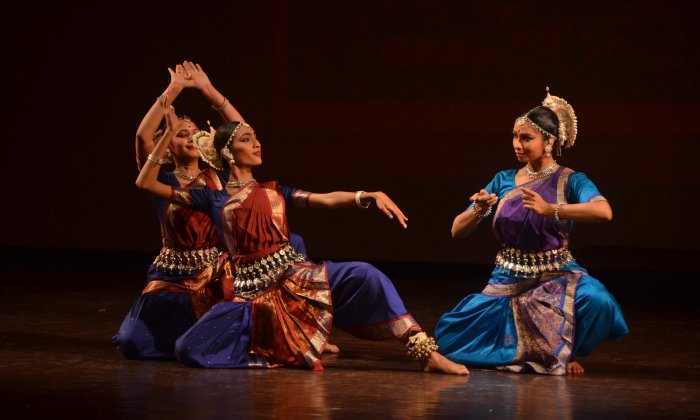 Mythology "Mythology" climbs to rare heights, representing power and divinity through dancing forms. Five Odissi dancers depict Shiva as the cosmic dancer, with his four arms and flying locks symbolizing a multitude of ideas. The idea of creation and destruction of the cosmos is symbolically and metaphorically narrated through legends that form the foundation of dance offerings, guiding the society towards righteousness. The great mythology of Dashavatar is enacted in full in Odissi. 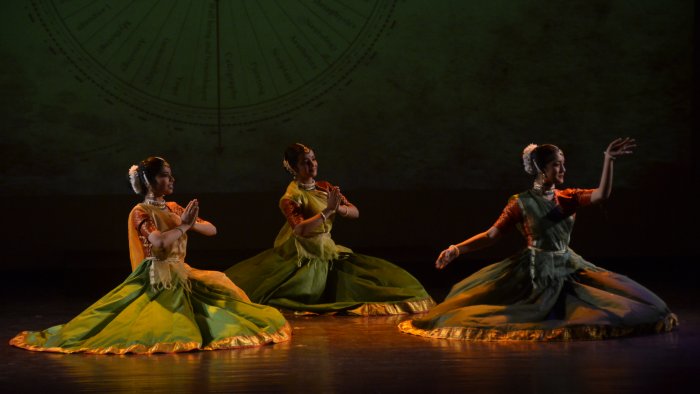 Poetics in dance 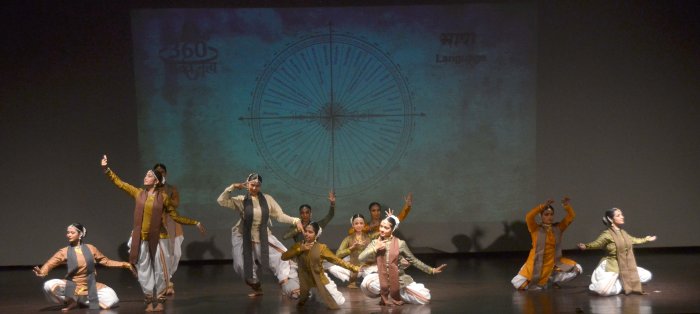 Dance as Language "Literature / Poetics" comes next, depicting excerpts from Chitra Kavya and Vilom Kavya. "Dramatics", the oldest way of looking at dance is taken up next, with performance from Kalidasa's Ritusamhara, bringing out elements of drama. "Language" follows, illustrating how a dance tradition is equipped with codified gestures around which a world of movement language is created. Some examples are enacted from Abhinaya Darpana on Hasta, Shira, Griba, followed by words, phrases, sentences depicted in dance language.  Hasta abhinaya 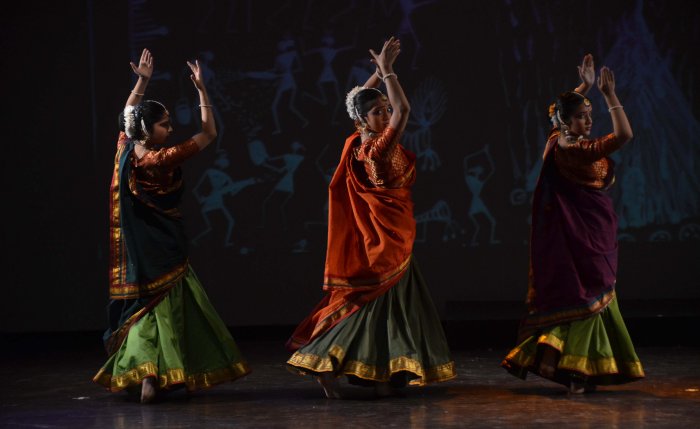 Ovi of Maharashtra Then comes "Sociology". For primitive peoples, dance was their principal form of communication: not merely as corporeal movement, but also for connecting the humans to their gods. Dance represents the symbols and meanings of how social groups live. Jaatyavarch Ovi sung by village women while performing daily chores was presented in Kathak. "Value Education" follows, where dance plays an important role in instilling values in the learners in an oblique way. Dancers present an excerpt from the earlier Mahagami production Sutra Atman, dedicated to Mahatma Gandhi, depicting 11 resolutions of Gandhiji that he followed in his struggle for awakening the country. "Vadya Kala" is an endeavour where the dancer - with her body as the medium and ghungroo as the instruments - weaves various footwork patterns in Kathak to represent the idea of dance as music; dance as melody; dance as Vadya. "Archaeology" comes as a reminder that a dance practitioner is a museum of her own art form, where she has acquired, imbibed and simulated a huge body of work, compositions, aesthetic sensibilities, historical facts and traditional knowledge. She needs to value archaeological facts and details with respect to ancient cultures, civilizational symbols and, importantly, information related to dance embedded in ancient inscriptions and artifacts. There is no performance on this topic and on "Management / Administration" that follows next as narrative. Dance represents dynamics and change, and puts the moving body at the centre of activities, which is ignored in the traditional management theory. Yet, 'Leadership' as a quality and as a dialogue is essential in the work of dancers and musicians who happen to manage groups without words.  Spirituality in dance "Musicology" rings out, without a performance, how dance incorporates a detailed insight into music traditions, music practices and musicology. It is interesting to note that Sharangadeva, in his treatise Sangeet Ratnakar, defines Sangeet as a composite term representing music, instruments and dance. In "Heritage" too, there is no performance, yet the narrative is eloquent as to how dance is one of the few art forms that simultaneously embellish space and time. Last of all, "Spirituality" is treated at length. Dance is an intrinsic part of human nature, being able to offer, to communicate, to connect and to elevate one's consciousness. Vallabacharya's Madhurashtakam is taken up in Kathak to glorify many forms of the sublime Krishna. An Odissi composition Om Manipadme Hum - based on Tibetan Buddhist chant -concludes the evening, seeking to sanctify the space around and within. Overall, it is a marathon programme to cover something like 36 disciplines of knowledge systems found around 360 degrees of gazing around! Hats off to the director for her bravery, consummate devotion to artistry and, above all, a near Spartan daredevilry in attempting to be so comprehensive!!  Dr. Utpal K Banerjee is a scholar-commentator on performing arts over last four decades. He has authored 23 books on Indian art and culture, and 10 on Tagore studies. He served IGNCA as National Project Director, was a Tagore Research Scholar and is recipient of Padma Shri. |



February 5, 2022
Meticulously planned by the Mahagami Gurukul, a two-day seminar Vidyagama featuring eminent Gurus, experts, mentors and educators, put the searchlight on evolving the right pedagogical paths for imparting training, enabling the teaching and sustaining of traditional performing arts - which, from their emergence in the guru/shishya sampradaya, have, with changing times, come to be included within the folds of university education programmes. Specialising in Kathak and Odissi, the training methods and ambience within the Mahagami Gurkul are reminiscent of the time honoured guru/shishya conclaves. Celebrating 25 years of dedicated service, Mahagami has combined the practice of the art forms with equally intense research oriented programmes -with knowhow in Sastra and Prayog going hand in hand. Since 2019, involved in designing and implementing pedagogical paths for training within the folds of the university, MGM University as it is now called, offers music, theatre, dance, Indic studies, and ancient languages. And marking Mahagami's silver jubilee, Vidyagama threw up several models of guru/shishya training along with much information and food for thought. But whether it resulted in a definitive pedagogical blueprint, would be difficult to state.
Starting the seminar, Parwati Dutta (Director of Mahagami) spoke of how the name Mahagami, an acronym for Mahatma Gandhi Mission (Sangeet Academy), was established on Guru Purnima day in 1996, involving her as director, on a journey of learning to learn how the intangible heritage of our traditional arts could be transferred to the next generation in all its glory - so that they not only lived but thrived under evolving eco systems. This artistic, cerebral and spiritual journey, which involved not just the performance aspects (concentrated upon today), but also the crucial knowledge aspect (which seemed to receive less attention) and which, she had realised, was transferred through various sources and avenues. Mahagami had concentrated not just on practice of Kathak and Odissi, but had taken the richness of these art forms by reaching out to people in far flung areas where these arts were not even heard of.
The moderators for the two day sessions were Parimal Phadke, a Bharatanayam practitioner working at Savitri Bai Vidyapeeth Dance and Music Institution of Pune, and Kaustavi Sarkar, an Odissi dancer working for Centre for Research and Dissemination of Indian Art, Charlotte, North Carolina, USA.
Speaking of her sixty years of training under late Guru Bipin Singh, Manipuri expert Darshana Jhaveri pointed out how her Guru had absorbed his expertise by imbibing learning from myriad sources like different Gurus, from temples and from deeply researching into the Sastras. His prime contribution lay in linking what was a purely oral tradition under the guru/shishya method, to the Sastras. A tradition based on primitive concept of cosmology like the Lai Haraoba along with Sankirtan and organic process of learning Raslila in the Vaishnavite temples from the time of Raja Bhagyachandra, and the extraordinary Sankirtan, are all equally important aspects of the Manipuri tradition. And while dealing with the journey from the temple and royal interiors to the contemporary stage, Guruji's reconstruction of training methods took infinite care to see that none of the richness of the old method was lost in the systematized process he introduced. Sitting movements, standing positions, bhramaris (both lasya and tandav), five Bhangi Parans were taught in a methodical way. An expert in tala systems, which he collected from several sources and the Sastras, many of the forgotten talas were brought back into usage by him through his dance visualisation. His intense research into old texts enabled him to see that what was done in the oral tradition linked with Meitei terminology for describing technique, had its parallels in the Sastras. Without being aware of it, the old methods imbibed what the Sastras prescribed. It was mentioned by Darshana Jhaveri how Guru Bipin, through his personal studies had discovered how terms like Mana, Vardhamana and Iyamana had their corollaries in the Sangeet Ratnakar. Meitei was very different from the Indo Germanic languages.
When queried about how one accommodated all these paramparas with what we today call secular with democracy of ideas, the point was made that all paramparas come from the sacred and that all our arts had a close link with Nature like Guru Bipin Singh's demonstration of the walk of a crow (Even in Sankirtan one has footsteps based on animal gaits). Ultimately concepts which are cultural symbols can be understood only by field work undertaken in the area where the particular parampara has had its birth and has thrived for years. It is imperative that one understands the cultural eco system under which an art form takes birth.
Ashok Vajpeyi, poet, writer and one of the best known art activists, whose work in Madhya Pradesh with Bharat Bhavan is only too well known, started with the statement that Art in India does not command public support and hence lacks sustenance. In blind pursuit of what goes by the name of 'modernity' barring theatre which is not loaded with the 'classical' burden, traditional arts like music and dance have suffered. Institutions for music and dance imparting, have regarded these art forms as 'skill' and beyond knowhow of technique have neither produced distinguished performers nor have they made contributions to research and documentation. Intellectual articulation is minimal, for they lack a cosmic vision, and the symbolism with inter-relationship amongst art traditions is unknown. On the other hand institutions started by positive, assertive non governmental agencies have done much greater work - like Kadamb in Ahmedabad, Sangeet Research Centre in Kolkata, Mahagami, Nrityagram, Rangayan Theatre, Bharatendu Academy etc.
In the final analysis, performing art needs to be rooted in Art primarily. Aspects of Guru's training need to be supplemented with other research. Does Kathak Kendra ever invite scholars in various fields to address the students? An artist group led by Ustad Vilayat Khan along with several other top artists and scholars like Arvind Parekh had met top political heads governing the country and asked for an exclusive channel for music and dance on Doordarshan, or for a system where four or five very carefully selected students are chosen for training under top Gurus - for which the Guru would be paid along with a modest scholarship provided for the students to enable them to pursue the training. Where is the corporate social responsibility with 2 percent earmarked for culture? The system of a small levy on tax payers would fetch enough to look after culture. Sangeet Paramparas, Classical Studies with Sanskrit scholars of unflinching vigour are all disappearing. In the west, art institutions are sustained by municipal committees. Mired in form filling and other time consuming formalities, it all seems like a well designed programme of amnesia. 'Adhoonikta' in traditional arts one must understand is different from the present arguments advanced in the new colonisation in English. One is reminded of Ghalib and Mirza who spoke of a world where God seems to be lost. Classical Arts are racial memory to be retained and animated through creativity and not through over dependence on technology.
Parwati Dutta remarked that one could not withdraw into one's own world of art because the ambience is not congenial. We have to pursue our outreach to the community and society we are in.
Founder of the dance institution Sutra in Malaysia, dancer Ramli Ibrahim whose tremendous contribution to dance and to Odissi in particular (for which he has found permanent space, on the map of a Muslim country) has earned him laurels like Padma Shri in India and the highest Datuk title in Malaysia, gave a sweeping account of his multi-cultural exposure in dance. An Engineering graduate from the University of Western Australia (who had worked with safety precautions and nuclear reactors), he moved on to Ballet training in the Australian School of Ballet in Melbourne (he mentioned the Soviet model of Sergei Diaghilev), rising to become a full-fledged solo Ballet performer in Sydney Dance Company. After meeting Chandrabhanu (the changed name of another Muslim dancer, originally Zamin Haroon) and Vijay Kumar Senapati with connections in Kalakshetra, he started Bharatanatyam training, going on to become a shishya of Adyar Lakshman. He also met Ram Gopal and became a good friend of his. In admiration for the broad based cultural approach of Australia, he mentioned how a grant from the Australian government in 1983 to study Odissi in Odisha, enabled his training under Guru Debaprasad Das (recommended by Indrani Rehman) after his visits to Kala Vikash Kendra in Cuttack and Odissi Sangeet Mahavidyalaya. Following the premature death of the Guru, Ramli was mentored by the Guru's seniormost students (He mentioned Gajendra Panda - though there were others earlier).
Not surprising that this multi cultural background with the cross trained body learning to move in myriad techniques, gave Ramli an incisive feel for bodies with the capacity to move in any which way, without being locked into one method of moving. With his work even now involving productions in Modern Dance and in Odissi mostly, honing the instrument of the body forms the main part of his training of aspirants in Sutra Foundation. He takes from Yoga, Ballet, Contemporary Dance, Indian classical dance, and maintained that students trained by him have 'a slightly different body' (their araimandi is from the pelvis and involves more than just a half squatting posture with a sideway knee bend), with the ability to move in different ways. He mentioned how scholar, writer, painter late Dinanath Pathy's close association with him had given him a feel for the broader Orissan identity with its kinship and historical ties with Java and Bali. His Guru Debaprasad, with his strong feel for folk forms of Odisha, which coming from the culture of the soil were for him, the real progenitors of Odissi, did not believe in the adavu staples of Kelubabu. Dancers who wanted to improvise, Ramli discovered, were more comfortable with Odissi than Bharatanatyam.
Contemporary Modern inspired by Odissi, as Chandralekha whose contemporary was inspired by Bharatanatyam, is what he believes in. "A Tamilian once remarked that 'Rasa can only be evoked by a Tamil dancer' and I challenged it. The core of Indian dance is 'rasa' which involves scholarship along with beauty of execution with an involvement 'releasing the body from the shackle of inhibitions. Merely executing Karanas is not good dancing. Parampara is no doubt a dynamic thing and knowing the language a dance is based on, like Oriya for Odissi, certainly gives one an advantage. But by totally understanding what the sahitya says, from an expert, and imbibing its spirit in the dance, is what enables creating rasa. Many attitudes have changed today." He mentioned the extraordinary male dancers of Odissi trained under Bichitrananda Swain - whose bodies are androgynous. Ramli mentioned Dhaneshwar following both Kelubabu and Debaprasad styles. Ramli's work has involved working with the best of musicians and teachers from Odisha. Whether in Margam or away from it, it is good work which will survive. How did painters like Hussein and so many others develop their own styles? Ramli maintained that an open minded approach to the arts is the need of the hour. Quality will survive - no matter what.
In a fast changing world, the challenges today are many for art forms. Is dance a secure profession? With so much destruction all round today, and so much distraction, how can one generate in youngsters the concentration required for continued 'sadhana'? To strengthen that inner receptacle today's youngsters need to be in a place like Mahagami. Ramli summed up, "I can take the horse to the water, but how does one make it drink?"
Dr. Chetana Jyotishi Beohar of Raigarh Gharana Kathak trained under Kalyan Das Mahant and Guru Ramlal in the guru/shishya mode, earned her doctorate under P.D. Asirvadam and Professor Mandavi, and working for a long time under late Dr. Premalata Sarma for her Ph.D gave her scholarship special insight. As a dance historian who has authored several books, she was also the Director of SNA's Kathak Kendra at Delhi. Citing all dance Sampradayas as based on Prayog Dharma, Chetana despaired of our present system in art institutions where recruitment and promotions based on degrees, have allowed this prayog dharma to be forgotten. With copy paste books being churned out, the butter which needs to come out of mental churning is missing. One needs to be part of a system to be acknowledged and acquiring degrees has become a formality with no field work and with hardly anybody able to read Sanskrit and Persian Sastras, some who pass out are often ignorant of even how to study catalogues- not to speak about "moola granth". In the 5 years for research, a smattering of whatever is contained in Sanskrit, Persian, Urdu originals is all one acquires. But for a written report which means little, where is the constant supervision, with in-depth interviews, to sift out those who cannot make the grade - for research is not everybody's cup of tea? Students are often directionless and the holistic approach with the 'chintan' so crucial to our arts is totally missing. And acquiring a pass through persuasions is not unknown. The cream of aspirants often gets left behind, starting on the lowest of salaries. While Chetana herself was blessed in the ambience provided under Dr.Premalata Sarma which exposed to her deep insights into these art forms, the formal and starchy lecture room atmosphere of the university with nothing else to replenish it, barring bookish facts, will provide for little understanding of the cultural ethos of the art form.
Dr.Arshiya Sethi, a post Doctoral Fulbright, Nehru Fellow, Art administrator and critic, author, Arts institution builder and art activist, before examining critically the New Education and Policy and Performing Arts, as the editor touched on the open access, South Asian Dance Intersections Journal (of which the first issue will soon be out). The journal aims to feature through its scholarly articles on South Asian Dance and its interdisciplinary intersections, the quieter as well as the more active voices in the field.
On her topic of the New Education and Culture Policy, with commendably high aims of access to qualitative education for all by the end of 2030, with the promise of creating an equitable just society in the country and the world there is a confusion on how to define art - as culture, as skill or as education. One must also keep in mind, said the speaker, that Culture in India is a very broad term, meaning not just dance, music, painting etc (spelt with a capital C) but also lived aspects of life (Culture with a small c). And we as a country have never had an overtly stated cultural policy, and all its sections, come under different ministries - Dance, Music and Theatre under Ministry of Culture, Film under the Broadcasting Ministry, Food under Tourism etc. The Ministry of Culture, while keeping supposedly autonomous government institutions of art at arm's length, according to the policy (we know how persuasive tactics are used for government appointments, for funding and for earning laurels like Padma Shri), provides grants and financial assistance. States in charge of regional arts, however, suffer from a chronic lack of funds. Arshiya cited some points underlined by Arundati Ghosh, that funding schemes do not take into consideration crucial aspects like rehearsal spaces, and quality training. Even in the very modest amount allotted to the Ministry of Culture, only seventy percent according to one research is spent. Scholarship for research grants prioritises classical art as superior and nobody in the ministry seems to realise that this smacks of elitism. There is a majoritarian approach in underlining traditional classicism and areas like Islamic (or Christian) arts, Contemporary Dance, and above all tribal and Folk Arts merit less attention. This creates an insular cultural approach.
The favourable point is that there is now a greater attempt at a re-look at vocational training and trying ways of bridging the urban/rural gap. While trying to recapture the guru/shishya flavour, critical thinking is not given enough importance. While we keep harping about retaining the richness of art from the past, what about the future? What are the employment opportunities for those with art degrees and specialisation? With 230 Anganwadis with no water, are we building castles in the air and is this vision achievable, particularly now with the Covid pandemic? With school dropouts due to poverty, the real problems of the future to be solved will need really imaginative teachers of education. Arshiya Sethi mentioned Delhi State's prioritisation of education, with increased resources and schemes like Happiness Curriculum as worthy attempts. The point is whether it is the exploratory pedagogy model or the prescriptive pedagogical model one really prefers. Rather than an either or approach, sensitive planning one would think, should be a blend - namely retaining the best aspects of our past, while providing scope for art springing from contemporary sensibilities and changing cultural ethos.
Considered the most pristine form of North Indian classical music, Dhrupad (conjunction of terms Dhruva and Pad) which emerged during the 16th century in the royal courts of Man Singh Tomar of Gwalior and kings like Akbar and Jehangir, is more like a form of meditation. This totally oral tradition has retained its indigenous nature, with its teaching remaining solely within the guru/shishya confines. Dhrupad artiste Nirmalya Dey, after initial training under Nimaichand Boral, a disciple of Nasir Moinuddin Dagar, came under the renowned Ustad Zia Fariduddin Dagar, representing the 19th generation of an unbroken tradition of Dhrupad performers. Describing Dhrupad as an experiential and creative art, where the unfolding of a raga comprises a very gradual opening out, tone after tone, the crucial holding of a note or swara has elements special to this genre of music. For absolute control, voice training becomes the most exacting part of learning under the Guru. One becomes aware of the very unique aesthetics of Dhrupad through years of close observation of, and exchanges with the Guru. Nirmalya Dey spoke of how his Guru always said that 'swaras' were never fixed and that they have a gait. The hours spent on Kharaj Sadhana (voice training) enabling the perfect awareness of micro tonal inflexions in the very gradual development of a raga in alap - with embellishment elements like Meand, and in Dagarvani, Nirmalya Dey's demonstration showed how Kharaj Sadhana includes exercises in staccato (involving a dot or stroke above or below a note without voicing it fully which is a system used in western music but not Indian music). Alap, while sans words, has in Dhrupad a textual content of sounds "Aa Raa Na, titira, Ri, Nana" and so on which are an important part of rendering Alap. The short Pada component of course has words. Stepping into Dhrupad training cannot be with any pre-conditions - and material expectations cannot be guaranteed. "My Guru always said Sabar karo Beta!" Imparting the same kind of training today with hours spent in just voice training is not possible. So a module for the learner of today, who at best may be able to devote a couple of morning hours to rigorous sadhana before starting the day for mastering an art form like this, is hardly sufficient.
Senior scholar/dancer Padma Subrahmanyam in a brief message of Sastra and Sampradaya going together said that the Natya Veda which is Sastra (knowledge) and Veda (wisdom) is both art and science. Science relates to the right side of the brain and intuition comes from the left side - and one needs both - which Sastra and Prayog provide.
Dr. Parul Shah, senior Fulbright scholar, former dean of M.S. University of Baroda, in her address throwing light on Dance Resources using technology, began with words of homage to her Guru late Anjali Merh (who passed away in 1979 and was one of the top students of Rukmini Devi at Kalakshetra), before settling down in Baroda after becoming a post graduate of M.S. Baroda University. After all, Anjali's involvement with Tamil and Sanskrit in Kalakshetra which had turned her into a typical Tamilian Mami, to creating an entire repertoire in Gujarati as part of Bharatanatyam, was a big step. She did a whole Margam, and even Chandramauleeswarar Kuravanji in Gujarati. She also choreographed plenty of Nirupanas in Marathi. It was Sayajirao Gaekwad III's marriage to a Tanjore princess, with devadasis and a nattuvanar as part of the dowry that had sown the initial interest in Bharatanatyam in Baroda. The one to one guru-shishya system with only performers from hereditary families, changed with institutionalizing the training system. Along with theory and practice, vocal music or sitar to supplement the dance has always been insisted upon. She mentioned that departments controlled by five independent teachers along with the universalisation of dance, an open minded approach with no class allowed more than 10 students (actually there were 3,4,5 to a class) all added up to a white elephant - expensive to maintain. Along with the guru/shishya, using audiovisual aids and objects, to spark interest and enrich attention spans and learning has always been a practice - supplementing and not replacing the teacher/taught relationship.
From 1960s, early computers provided a new dimension of learning and during the pandemic, online teaching has provided the main and often only link between guru and student. If the teacher wants to make students aware of the Kalakshetra Bani or what Padma Subrahmanyam does in her style, or if one wants to listen to old music compositions, obviously a video is the best method in the absence of a live presentation. Resource material in the university is designed to facilitate the student's learning. A 'Sakhiye' Anandabhairavi varnam as taught by old nattuvanars, as visualised by Guru C.V. Chandrasekhar, or the way she herself has choreographed the varnam are all different from one another. Only flat feet or heels or toes can be used to create rhythm and yet how many variations, we have! Electronic learning patashalas can stir an appetite for learning with tools and if enthused sufficiently, the person concerned will try and find a teacher for live classes. Even rural areas can access this information. And let us not forget, that what in live teaching, if not absorbed, is totally lost in an online method, can be seen again and again till grasped. Parul summed up with the statement that learning, churning and creating are all possible through such technology. Their university has resources providing scaffolding of knowledge through audio visual aids pertaining to - detailed study of the Natya Sastra, Dance and Theatre - Rupaka and Uparupaka, Devadasis presenting (what is now called) Bharatanatyam, nattuvanars teaching, Kathak dance by Nautch girls to the present greats, dance in India today, with accent on Diaspora, Modern Dance, dance dramas and Mask Dances of Asian Pacific, Myanmar etc.
Kathak exponent Shama Bhate, disciple of Rohini Bhate, just touched on the ancient guru/shishya teaching where one imbibed the art form by staying with the Guru. In this two way relationship of passing on and absorbing the philosophy, the values and way of life that were part of a tradition, the generosity of a Guru and the capacity to absorb in the student, were what mattered. Like the Sandeepani/Krishna relationship both sides have to vibrate with equal vibrancy and energy like the strings of a tanpura. Bhimsen Joshi who went in search of a Guru ultimately found Savai Gandharva in his own State. While Guru Rohini Bhate's Nritya Bharati classes were for two hours, and only three days a week, it was still in the guru/shishya mode, and "she ignited flame in all hearts through her teaching, which was multi-disciplined. Shilpa, Sastra, cinema, poetry, technique, knowledge 'Chaturasra', discussion about ragas, composing movement before disciples - all this gave us a rounded training. And Pune in those days had no Kathak Guru and interested people had to travel to Lucknow or Kanpur to learn. And yet we know that the way we learnt is not like the ways either Bhimsen Joshi or even Ravi Shankar under Allauddin Khan learned." When holding workshops began, what was criticised as patchwork lacking homogeneity is now accepted even by her. For instance, through workshops she has learnt something of Birju Maharajs aesthetics. She has been learning laya under tablist Suresh Talwalkar and that has been very helpful in her Kathak. Today's institutions like Bhatkhande College and Lalit Kala Kendra have under the university structure tried to combine the best of both worlds. Her approach is that if one can take classes in Africa or America, why not workshops? One can internalise and imbibe something, along with your main bani.
Musicologist Vidwan Dr. R.S. Nandakumar, son of the reputed scholar and musicologist Late Dr. R Sathyanarayana, looking at Sangeet Prayog and Sastra, referred to the flow of tradition in three stages, through the metaphor of a river's flow - upstream, midstream and downstream enveloping Sangeeta Sastra, the Shishya Parampara and the travails of the present. He cited the example of SaPa Institute of Bangalore conceived by L.Subramaniam as an ideal for teaching and above everything, sustaining a learning climate for music. Concerns of form and content, methodology of teaching and techniques of assessing aptitude and performance, along with thought on the support systems are all important aspects of sustaining this effort. Apart from the aesthetic, social and educational values, music helps the emotional integration of society and while adding academic richness, it stirs or should stir enquiry and academic thought. Todays upstream, with the impact of global interaction, has changed from the original purely India centric concerns. The idea of music only for the sake of music (Art for Art's sake) no longer holds true, with concerns like catering to market forces, the utilitarian aspects of music have assumed importance.
While speaking of teacher/taught bipolar process, one liked the speaker's open mindedness in saying that there could be no one prescription for music education. He believed in conducting classes amidst nature - in hilly areas, in deserts and what have you. Orderliness and dynamic system is what he prescribed, while doing away with judgements of slotting students into various stages of excellence. The really committed and special would on their own pursue a career in music. In a way, Nanda Kumar's approach of spreading musical awareness in the general student population seems one way of being assured of a music initiated people who will provide excellent audience material for musicians. This educating of 'taansens' as it is said, is the best way of ensuring an audience for music, creating a climate for ensuring its survival through changing times.
Dr. Anil Behari Beohar's address on Areas of Caution and Care in University Education was an example of explaining in the simplest of language one of the most crucial aspects of Art Education within the university fold. For one who, undeterred by the drawbacks of visual impairment, rose to become a Hindustani music violinist, earning his credentials, and doctorate from Indira Kala University of Khairagarh and Benares Hindu University and even today is an empanelled examiner for PhD students in several universities, art education starts with the right ambience in schools and home for sensitising the child's mind to music -simplicity is the key for anything heavy (like Khayal singing) with its complexity will detract instead of attracting the youngster. The proper modules are needed for being able to asses an aptitude for an art form (a voice for tuneful singing, an eye for colour and drawing (for painting), and a body with grace of movement (if dancing is the objective)) along with the ability for concentration and the resilience to pursue and cultivate the talent - all this along with creative imagination.
Dr. Beohar mentioned how our present system has led to only square pegs in round holes today - with those qualified with high degrees of B.A and M.A. in Music, employed with very poor emoluments, in jobs which demand little more than teaching Rashtriya gaan, Vande Mataram or a Bhajan - with nothing one has qualified for, being put to use. The faults start with the education system, where after the teacher gives the students the outline of a raga or a tala, the student is asked to familiarise himself with it through practice in his room. The teacher is satisfied that he has completed the course, without any assessment of how what he has taught can be taken further by the student. The tyranny of numbers where one promotes all or fails all, through a written examination which judges by answers to questions on theory, forgets that Prayog or practice is the acid test for an art form. Limiting 5 to 6 students per class should be the rule for art universities cannot cater to multitudes. Small control rooms fully equipped with a sound system controlled and heard by a teacher outside, where students regularly rehearse, with corrections for each student in a cubicle, by the teacher who accesses all studio spaces through pressing a button, is the kind of course correction that music students need. This constant guided rehearsing is imperative, along with tests wherein students are asked to assess critically, without malice, one another's efforts, sharpening critical faculties, making for better musicians. And no art education can insist on a time limit. A raga fairly well grasped in five years by one student may require more years for some other student. Prof Beohar mentioned 12 years for an M.A. degree and not the present 5 years.
Teachers being assessed through a written examination and cursory interview is not right. Teaching is a highly specialised skill involving not just knowledge in the subject one teaches but the ability to stir the student's imagination while passing on the information. A teacher's ability should also be assessed by the type and number of worthy students he can turn out. And while in the process of teaching the overused voice of the teacher may get blunted (and this has happened often), he has to find a way to enthuse the reception, the retention and reproduction and imagination of the student. When questioned about a system of assessing insights and reflective ability on the art form, in the structured university system, Dr Beohar suggested that connecting one who has passed with the teacher who has trained could be one way of keeping teachers on their guard, without becoming indifferent because of job security. The teacher's confirmation should be connected to the results he has produced through his teaching. Ways of self motivation are needed for teachers too, who often become complacent and indifferent. Clearly much food for thought for Mahagami, which is very cautiously taking steps for art teaching within the folds of a University.
Sans the slightest trace of artifice about her, every word uttered by Nahid Siddiqui, a rare inclusion from Pakistan, came from the heart of a lived-in experience. The only claim she made was, "I have been able to place Kathak on the Pakistan map." Indeed, those who have seen her exquisitely involved performances, know that she is the one shining light of Kathak in that country - who needs far more recognition than she has earned. The country has yet to realise that what they have in this dancer is very rare in any form. Brought up in a forward looking household, the not very favourable climate for dancers in Pakistan at the time drove her away from the homeland, re-adapting her learning and shaping it for outside cultures. She had met her Guru Baba Maharaj Ghulam Hussein, the only Guru in Lahore, and crazy as she was about dance, would spend the entire day at his place, bowing to that space. Not a great master, he was nevertheless part of the very traditional Kathak evolution. Happy to have a dance crazy student, his traditional teaching with nothing like warmups, never corrected her in finer details. But she knew that what she got from him was great material, and she danced with vigour learning under this sole teacher in Pakistan for five years. Before Partition, Ghulam Hussein Khan had learnt from Achhan Maharaj as a gandhaband student. When Nahid got the chance of going to India, she sought her guru's permission to learn from Pt Birju Maharaj - also making clear that she would not go if he did not agree. After three days of thinking, the Guru gave her the permission with a letter reminding Birju Maharj that he, as a child, had sat on his lap in Rampur Nawab's palace.
Totally unexposed to dance glitter, Nahid approached Kathak more like an archaeologist, till Pt Birju Maharaj gave her an entirely different aside on the dance. He wanted to know what she had been taught, and as she just she took a 'thata' posture, he remarked that what she had shown belonged to the old school, not seen today. While he taught her with sincerity, what her mind opened to was not his special tihais or tukras (for she realised that her sense of aesthetics was different) but to the idea of looking closely at the aesthetics of the form itself. Thus, she was sufficiently evolved to know what exactly she needed to absorb from another teacher. Her deeply analytical mind started on a voyage of discovery - that a line does not have to be absolutely straight for aesthetics. "I am doing calligraphy when I dance." Aesthetics and spirituality, she realised, go hand in hand. "Base of our art is spirituality." To go beyond body and form, one has to imbibe the art form internally. There is no place for ego here, she said, for when people see the dance, they have to forget the person Nahid. "The process is the art," she remarked. Rooted in her soil, the foot contact with the earth was essential for her. Because she was banned from dancing, she had to go out - but came back, even more rooted in the process. Only one rooted in one's traditions can go beyond it and break boundaries, she claimed. She sticks to traditional music, poetry of Hazrat Amir Khusro, Rumi and others, and she is led by the harmony of the music. The design of the dance is from life. With a base in love and care, she transferred knowledge to foreigners, never thinking of them as the other. In the after talk interactions, she mentioned collecting old 'Nagma' tunes - which reveal the tala straight away without any need for the loud, frequently intrusive tabla of today. There was a feeling expressed that Mahagami would love to have dancers get together on this point and together make a collection of precious musical refrains, so important while dancing Kathak nritta. As Nahid put it "Bheeja hua nagma needs no sangat - and unfortunately is becoming a forgotten part of the art."
Dr. Chaitanya Keshav Kunte, Assistant Professor of Arts at Savitri Bharati University, touched on the Role of Archive in Furthering Music, by understanding musical past vis a vis musical present and creation. Generally, archival material is not published, and in oral traditions not documented in physical form. Archival material is different from libraries, for it is donated and not purchased and preserved collections are of great value in classifying, systematizing, in re-creating and for dissemination. His Guru was Dr. Ashok Ranade. Dissemination requires a proper perspective holding a mirror to culture - warts and all. Enables re examining, re-orienting and re-activating cultures so that the present becomes 'live', meaningful and relevant as a link with the past. Here it is art rather than artist, for individuals are not important. Gradual archiving is needed to accommodate stances. Upheavals, sudden or abrupt starts and ends are not in favour. Archiving and tradition are mutually connected. He mentioned the huge archiving treasures of the Dr. Ashok Ranade archival collection. It comprises anthropology, folklore, religion and philosophy, plays, old plays and thumri compositions and huge audio visual material. He played a small section of the thumri with the singer in a bhav batana of the thumri "Ghiravi prana sakhe."
Today, he said we are using the instructional method instead of the exploratory method. He mentioned SNA's archival library, which is rich. But few people have access - and very often as this writer knows, there are recordings listed of talks and performances, but without the material in the library. Very often one is told, "Sorry, that is not found." This writer remembers reading about an interview of Prof Saxena by Maya Rao. Listed in the records, the tape is missing.
All told, it was a seminar yielding much food for thought! And that Mahagami arranged such an event with such care, goes to its credit.
After listening to such experienced voices talking about art education in Vidyagama, one sees the utter degradation in the performing arts institutions, with real sadness. Where are our standards when it is lobbying and political push, which is aiding the Padma Shris of dance today? Have artists totally lost all sense of right and wrong? How can an SNA award or a government title earned through bludgeoning all criticism through political powers, give one a feeling of satisfaction? What are our standards for judging whether a dance form, supposedly reclaimed from an old text, is 'classical?' And one hears that such people are striving to head the SNA, which for close to two years now, has been headless. When there are so many specialists who are qualified, are we really making use of their strict supervision, before deciding on great awards? When we are insisting on non corruption in all areas, why are the arts becoming so prone to politicisation and wrong practices? Arts are supposed to make people sensitive. But when massaging individual egos of the less talented takes over through using political means (and I blame the artists for this), where are we headed? Our dancers want lamp lighting by a political bigwig for all their functions - this has become a way of seeking legitimacy. And pictures taken are published in all papers - showing how powerful the dancer is! Unless artists themselves realise what is happening and protest, our classical arts are in for a bleak future.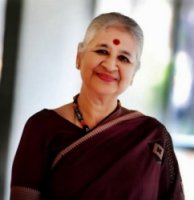
Writing on the dance scene for the last forty years, Leela Venkataraman's incisive comments on performances of all dance forms, participation in dance discussions both in India and abroad, and as a regular contributor to Hindu Friday Review, journals like Sruti and Nartanam, makes her voice respected for its balanced critiquing. She is the author of several books like Indian Classical dance: Tradition in Transition, Classical Dance in India and Indian Classical dance: The Renaissance and Beyond.
Bhagat Singh to Buddha: Dance, theatre mix in out-of-the-box presentations
At the Indira Gandhi National Centre for the Arts (IGNCA) was an unusual film on “Vaikhari” produced by Lubdhak Chatterjee, sponsored by Public Service Broadcasting Trust (PSBT). An engineering graduate, Lubdhak attempts looking at “parhant” or the articulation of mnemonics in dance through imagery visually caught on the camera, the film seeking to look at the nature of pure sound and how it connects with form in dance, art and in life. The pattern of sound arrangements in rhythmic phrase and their utterance can suggest a “bindu”, a “rekha” and an “akaar” (dot, line and shape) all attributes of form! In a scene showing Kalidasa’s Meghadootam, sounds like “Ghe ghe tita” suggest the dark clouds which the Yaksha separated from his beloved — and the messenger carrying his words of love to his beloved. Inanimate sound through its patterning and “chhand” becomes an abstract symbol suggesting form. The spacing of the “bols”, the silences, can all convey phrases of movement. The bols in a “bandish” can suggest chirping birds, rain of varying intensity (drizzling or pouring) and many other things. Through the utterance of certain sounds arranged to create a certain effect, in a purvaranga invocation, a canvas is created which the dancer later fills through her dance. Shot almost completely in the variety and beauty of the Mahagami dance institution premises, one sees director Parwati Dutta speaking to her students and directing them on sounds translating to movement, with references to texts. With sounds filling up space, filmed sculptural exuberance of temple architecture acquires a special vibrancy. Sound vocabulary in dance has been inspired not just by percussion mnemonics, but also by nature and its inhabitants. In a brief guest appearance, Pandit Birju Maharaj explains how tonal inflections and every little turn and shift in the syllabic punctuation of a rhythmic composition suggests movement inflections. Parwati mentions Nirgeet, a thousand year parampara, and following her Kathak references also gives examples from the other form she practices — viz Odissi and points to the Vadya Pallavi based on mardal mnemonics, on which she worked with the late Banamali Maharana. A very interesting visualisation of how what is called nonsense syllables finds expression through movement and form.
30 years of ASEAN-India ties celebrated at Udaipur The 9-day camp included artists from ASEAN countries Indonesia, Philippines, Malaysia, ...


